Concrete Leveling for Home Inspections — Complete Guide
Concrete Leveling Home Inspections — The Complete Guide
If a home inspector flagged your sunken driveway, cracked walkway, or settled patio, you need answers fast. This guide covers concrete leveling home inspections from the seller's side: why inspectors flag settled slabs, which repair methods satisfy re-inspection, and how fast you can realistically get the work done before closing. You'll learn when mudjacking fits, when polyurethane foam is the better call, and how central Iowa's clay soils shape both the problem and the fix. By the end, you'll know exactly what to do between the inspection report and the closing table, and why concrete leveling home inspections so often resolve faster and cheaper than sellers expect.
What You'll Find in This Guide
Why Home Inspectors Flag Sunken Concrete (and What Buyers Do With It)
Home inspectors in Des Moines flag settled concrete for two main reasons: safety and water. A slab edge that sits more than a half inch above its neighbor creates a trip hazard, and inspectors note trip hazards almost without exception. Meanwhile, a driveway or walkway that slopes back toward the house directs runoff at your foundation. Inspectors flag negative slope because it points to a bigger future problem, not just a cosmetic one.
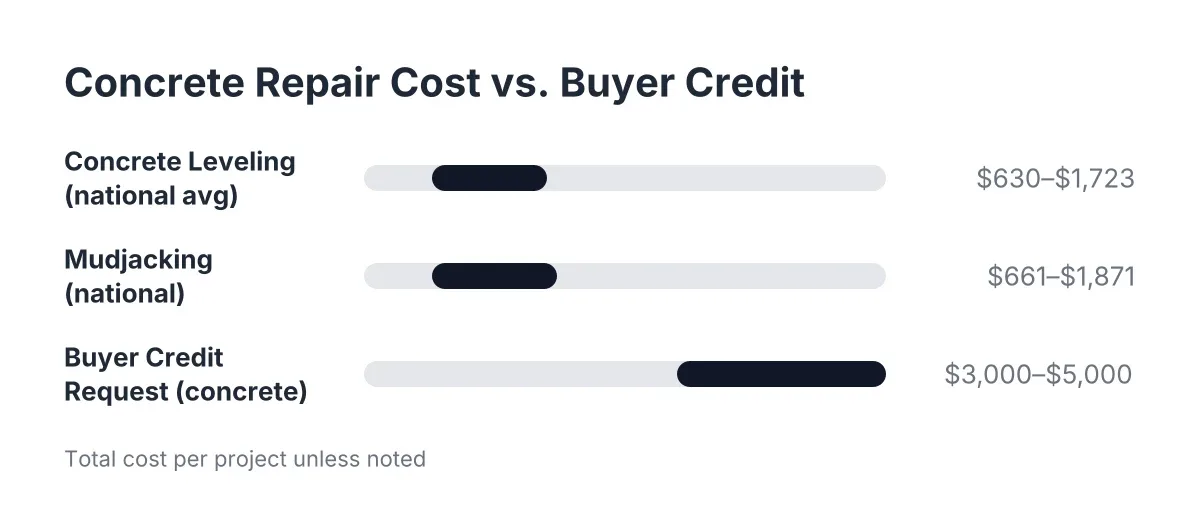
Here's what most sellers don't realize until it's too late: the inspection report itself rarely kills a deal. Instead, the buyer's agent uses the flagged items as negotiation leverage. A cracked, sunken driveway on an inspection report often turns into a repair credit request of several thousand dollars, because buyers price in the worst case — full replacement. However, leveling the existing slab typically costs 25% to 50% less than tearing it out and pouring new, according to HomeAdvisor. That gap is your negotiating room, and it's exactly why fixing the issue before or during the option period usually beats handing over a credit.
This is also where understanding concrete leveling home inspections pays off directly. Once you know inspectors are grading conditions, not construction methods, you can respond with the fastest, least expensive fix that clears the flag rather than the most expensive one a buyer might assume is necessary.
The Des Moines Factor: Clay Soils and Freeze-Thaw
Central Iowa sits on expansive clay soil. This clay swells when wet and shrinks when dry, so slabs poured on it settle unevenly over the years. Add our freeze-thaw cycles, and you get the classic Des Moines pattern: a driveway that drops near the garage apron, a front walk that heaves at one joint and sinks at the next. Local inspectors see this constantly, and they know the difference between routine slab settlement and structural foundation movement. That distinction matters, because slab settlement is a fast, affordable fix, while structural movement is not.
As a result, your first move after a flagged inspection should be a proper assessment, not a panic call to a replacement contractor. Most flagged concrete in the metro qualifies for leveling rather than replacement. If you're trying to budget before you even pick up the phone, our guide to what concrete leveling for home inspections costs walks through the three factors that actually set the price. For context, Angi and HomeAdvisor put the national average at $1,174, with most jobs landing between $630 and $1,723. That's a fraction of the credit a buyer will demand for the same problem, and it's usually a fraction of the timeline too.
Which Method Passes Inspection: Mudjacking vs. Foam for Concrete Leveling Home Inspections
This is the question sellers ask us most: "Will mudjacking pass inspection?" The honest answer is yes, when the repair addresses what the inspector flagged. Inspectors don't grade the method. They grade the result. If the trip hazard is gone, the slab drains away from the house, and the concrete is stable underfoot, the flag clears. So what matters to you is picking the method that fits your slab condition and your closing deadline, not chasing a particular technique because it sounds more permanent.
When Mudjacking Fits Your Timeline
Mudjacking pumps a cement-based slurry under the slab through small drilled holes, lifting it back to grade. It handles heavy slabs well, and it's often the budget-friendly option. Nationally, mudjacking runs $661 to $1,871, with most homeowners paying around $1,232, according to Angi. The tradeoff is weight and cure time. The slurry adds load to soil that already proved it can settle, so you'll want to keep vehicles off a mudjacked driveway for a day or two. For a walkway flagged as a trip hazard three weeks before closing, mudjacking is usually plenty fast, and the savings can matter if you're also budgeting for other pre-listing repairs.
When Polyurethane Foam Is the Better Call
Polyurethane foam injection lifts the slab with expanding foam instead of slurry. The foam weighs almost nothing, cures in minutes rather than days, and the injection holes are smaller. Consequently, foam is often the right choice when your re-inspection is days away, when the slab sits over soft or saturated clay, or when a buyer's final walkthrough is imminent. You can typically drive on a foam-lifted driveway the same day, which matters most when your closing date has no room left to give.
We're a concrete leveling specialist, not a franchise running a template playbook, so we'll tell you plainly which method fits your slab instead of pushing whichever one we sell. Some jobs genuinely call for mudjacking. Others call for foam. A few call for crack filling and resurfacing on top of the lift, because an inspector who flagged "cracked and settled" wants both conditions addressed, not just one.
What to Show at Re-Inspection
Keep your invoice and any before-and-after photos on hand. Inspectors and buyer's agents respond well to documentation that names the repair, the method, and the date. In practice, a leveled slab with paperwork clears re-inspection faster than a leveled slab with only a verbal explanation. If your contract requires proof of professional repair, that invoice is your proof, and it's worth requesting it in writing at the time of the job rather than after the fact.
Your Pre-Listing Concrete Repair Timeline: From Flag to Closing
Closing deadlines drive everything for a pre-listing seller. So here's the realistic timeline for concrete leveling home inspections in the Des Moines metro, from the day the report lands to the day the flag clears.
Days 1–3: Assessment and Quote
Most leveling assessments take under an hour on site. A specialist measures the drop at each slab, checks joint condition, and looks at the soil situation underneath. In central Iowa, that means reading how the clay has behaved: washout near downspouts, settlement along the garage apron, heave at shaded joints. You should walk away from the assessment with a firm quote and a method recommendation, not a vague range. Anyone who quotes you sight unseen is guessing, and our cost guide for inspection-driven concrete leveling explains why the number of slabs, the depth of settlement, and the method matter more than square footage alone.
Days 3–10: The Repair Itself
Here's the part that surprises sellers under deadline pressure: the actual leveling usually takes hours, not days. A typical flagged walkway or driveway section lifts in a single morning. Crack filling and joint sealing happen during the same visit. The scheduling window, not the work itself, is your real constraint, so call early in your option period rather than the week before closing. That said, foam jobs give you more flexibility because cure time is nearly zero, which can be the difference between meeting a tight re-inspection date and missing it.
Before Closing: Re-Inspection and the Money Question
With the slab leveled, drainage corrected, and cracks sealed, the re-inspection is usually a formality. Beyond clearing the flag, the repair often makes financial sense on its own. According to Angi, concrete leveling projects can recoup 70% to 90% of their cost in added home value. Compare that with the alternative: crediting the buyer for full replacement at a price you never verified. Sellers who fix the concrete keep control of the cost. Sellers who negotiate a credit instead hand that control to the buyer's contractor, along with the final price tag.
One more point on standards: home inspectors in Iowa generally follow published standards of practice, such as the InterNACHI Standards of Practice, which focus on observable conditions like trip hazards and drainage. This means that once the observable condition is fixed, the item clears. There's no hidden bar to meet, and no requirement that flagged concrete be replaced rather than leveled. That's good news for any seller weighing concrete leveling against a full teardown.
Frequently Asked Questions
Does leveled concrete need to match the original slab's finish to pass inspection?
No. Inspectors check for safety and drainage, not cosmetic uniformity. A leveled slab with minor color variation at the injection points still clears the flag as long as the trip hazard and slope issues are resolved.
Can concrete leveling be done in cold weather before closing?
Both mudjacking and polyurethane foam can be installed in cooler temperatures, though extreme cold may affect cure time for mudjacking slurry. Foam remains a reliable option when weather adds pressure to an already tight timeline.
What if the inspector flagged multiple slabs on the property?
Most specialists can quote and schedule multiple slabs, such as a driveway, walkway, and patio, in a single visit. Bundling the work often saves time and keeps your repair timeline aligned with a single re-inspection date.
Ready to Get Started?
If an inspection report just flagged your concrete and the closing clock is ticking, don't guess your way through it. Des Moines Concrete Leveling Pros will assess your slabs, tell you plainly whether mudjacking or foam fits, and get the work scheduled to beat your re-inspection date. Call us today and turn that inspection flag into a cleared item before your buyer's agent turns it into a credit request.