Concrete Resurfacing — Complete Guide
concrete resurfacing cost — The Complete Guide
Worn, pitted, or spalled concrete makes an otherwise solid slab look decades older than it is. This guide explains what resurfacing actually does, how it differs from leveling, and what concrete resurfacing cost looks like compared to full replacement. You will also learn when resurfacing pairs with slab lifting for a like-new result, and when it cannot fix the underlying problem. If you own a Des Moines home with aging concrete, this page helps you buy the right service the first time instead of paying for a cosmetic fix that fails within a season.
What You'll Find in This Guide
Coming soon — we're building out this topic cluster.
What Concrete Resurfacing Fixes and What It Cannot
Concrete resurfacing applies a thin, bonded overlay over an existing slab. To put it simply, it gives old concrete a new skin. The overlay hides pitting, minor spalling, surface cracks, and the dull gray wear that comes from decades of Iowa winters and de-icing salt. Done well, a resurfaced driveway or patio looks close to freshly poured concrete at a fraction of the price, and understanding concrete resurfacing cost upfront keeps that price in perspective.
However, resurfacing is a cosmetic finishing step. It does not lift a sunken slab, and it does not stop settlement. This is the single most common point of confusion we see with Des Moines homeowners. A slab that sank two inches at the garage apron will still sit two inches low after resurfacing. Worse, the overlay will crack along the same lines the base slab moves along. If the concrete beneath keeps settling into central Iowa's expansive clay, no surface product can hold it together.
A quick way to think about candidacy: resurfacing works well when a slab shows any of the following issues on an otherwise stable, level surface:
- Surface pitting or flaking from freeze-thaw damage
- Minor hairline or surface-only cracking
- Dull, discolored, or worn finish from age and salt exposure
- Small chips or spalled edges that have not spread through the full slab depth
If instead the slab has dropped, tilted, or cracked all the way through, structural correction has to come first.
Why Des Moines Concrete Spalls in the First Place
Central Iowa gives concrete a hard life. Our clay soils swell when wet and shrink when dry, which shifts slabs season after season. Meanwhile, freeze-thaw cycling drives moisture into the surface, where it expands and pops off the top layer. That flaking is spalling, and salt accelerates it. The Portland Cement Association explains the freeze-thaw mechanism in detail through its published durability research, and the pattern matches what we see on driveways across the metro.
With this in mind, the right diagnosis matters more than the right product. Surface damage on a stable, level slab is a genuine resurfacing candidate. Surface damage on a slab that has dropped, tilted, or cracked through its full depth needs structural correction first. That usually means concrete leveling by mudjacking or polyurethane foam injection, followed by resurfacing as the finish coat. As a result, homeowners who skip the leveling step often pay twice: once for the overlay, and again when it fails.
For a pre-listing seller, this distinction decides whether buyers see a refreshed driveway or a patched one. For a safety-focused owner, it decides whether the trip hazard at the sidewalk joint actually goes away.
Concrete Resurfacing Cost Compared to Replacement and Leveling
Homeowners usually weigh three options: resurface, level, or tear out and replace. Each solves a different problem, and each carries a very different price. Because pricing varies by slab condition, square footage, and finish, treat any number as a starting point until a contractor sees your concrete in person and can quote actual concrete resurfacing cost for the job.
Replacement is the most expensive path by a wide margin. Demolition, hauling, forming, and a new pour add up fast, and the new slab still sits on the same clay soil that moved the old one. In practice, replacement makes sense only when the slab has failed structurally, with deep cracking, crumbling edges, or severe heaving that lifting cannot correct.
Where Leveling Fits in the Budget
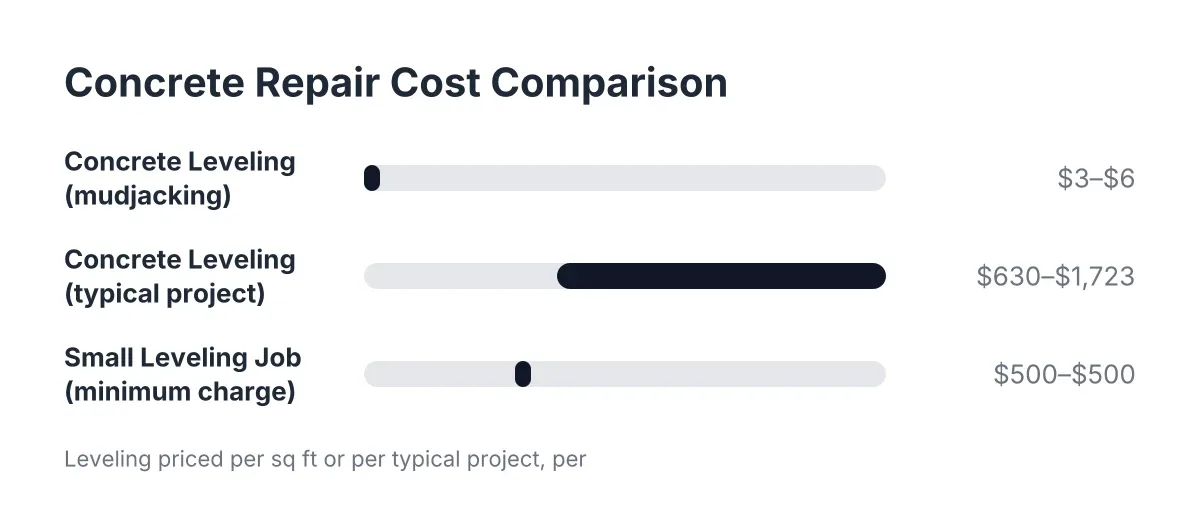
Leveling costs far less than replacement when the slab is sound but sunken. According to HomeAdvisor, mudjacking runs $3 to $6 per square foot and costs 25% to 50% less than replacing a concrete slab entirely. Angi and HomeAdvisor data puts the national average concrete leveling cost at $1,174, with a typical range of $630 to $1,723. For mudjacking specifically, Angi reports most homeowners pay around $1,232, within a range of $661 to $1,871. Additionally, small jobs may carry a minimum charge of around $500 even under 100 square feet, per Angi, so bundling several problem areas into one visit often improves the value.
Resurfacing sits alongside these numbers as a finish cost, not a structural one. This means the smartest budget question isn't what resurfacing costs in isolation. Instead, ask what the combined cost of resurfacing plus any needed leveling comes to, and compare that total against replacement. For most Des Moines slabs with surface wear and moderate settling, the combined approach still lands well below a tear-out.
Beyond that, the investment tends to pay back. Angi reports concrete leveling projects can recoup 70% to 90% of their cost in added home value. For a seller preparing to list, that math usually favors fixing over replacing or ignoring the problem.
To summarize how the three paths stack up:
- Resurfacing — lowest cost, cosmetic fix only, requires a stable and level base slab
- Leveling (mudjacking or polyurethane foam) — moderate cost, corrects settlement, often paired with resurfacing afterward
- Full replacement — highest cost, only necessary when the slab has failed structurally
Does Resurfacing Fix Uneven Concrete? Pairing It with Leveling
The short answer is no. Resurfacing overlays follow the contour of the slab beneath them. If your walkway has a raised joint or your driveway slopes toward the garage, an overlay reproduces that same unevenness with a fresher finish. Some self-leveling products can smooth minor dips of a fraction of an inch on interior floors. However, they cannot correct a settled exterior slab, and they were never designed to.
That said, resurfacing and leveling work beautifully as a sequence. First, a leveling contractor lifts the sunken sections back to grade using mudjacking or polyurethane foam injection. The choice between those two methods depends on slab condition, load, cure time, and budget, and an honest specialist will explain which fits your situation. Once the slab sits level and stable, resurfacing covers the drill holes, filled cracks, and weathered surface. The result reads as a like-new driveway or patio without a new pour, and the total concrete resurfacing cost stays reasonable because the overlay only needs to handle cosmetics, not structure.
How Long a Resurfaced Slab Lasts
Longevity depends almost entirely on what happens under the overlay. On a stable, properly prepared slab, a quality overlay can last many years, though Iowa freeze-thaw cycles are harder on any surface product than milder climates would be. On a slab that keeps settling, the overlay can fail within a single winter. For example, an overlay applied across an active crack will telegraph that crack back through the new surface as soon as the slab moves. Consequently, crack filling and crack repair should happen before resurfacing, and any settlement should be corrected first.
Product choice matters too, but less than preparation. Polymer-modified overlays, microtoppings, and stamped or broom finishes all perform well when the base is sound and the installer preps the surface correctly. In other words, do not let a product brochure drive the decision. Let the condition of your slab drive it, then pick the finish you want.
For safety-driven owners, this sequencing also settles the liability question. A resurfaced trip hazard is still a trip hazard. A leveled and then resurfaced walkway is safe, even, and presentable. That combination is what most Des Moines homeowners actually want when they first search for resurfacing options and start comparing quotes.
Ready to Get Started?
If your Des Moines concrete looks worn, sits unevenly, or both, start with an honest assessment before you commit to any product or method. Des Moines Concrete Leveling Pros will tell you plainly whether your slab needs leveling, resurfacing, crack repair, or some combination, and what each option costs for your specific concrete. Reach out for a straightforward evaluation from a local specialist who works with central Iowa clay soils every day.