Driveway Leveling — Complete Guide
driveway repair cost — The Complete Guide
A sunken driveway is usually the biggest concrete problem on your property, and the most expensive one to ignore. This guide breaks down driveway repair cost in plain numbers, explains how leveling actually works, and helps you decide between lifting your existing slab and tearing it out. You'll also learn how long a leveled driveway lasts in central Iowa's clay-heavy soil and freeze-thaw climate. Whether you're a new-construction homeowner watching your driveway settle or a seller prepping a house for listing, the answers here come from real Des Moines jobs, not a national franchise template.
What You'll Find in This Guide
Prefer to have a pro handle it? Driveway leveling is one call away.
What Drives Driveway Repair Cost in Des Moines
Most homeowners start with one question: what is this going to cost me? The honest answer depends on three variables. First, the size of the sunken area. Second, how far the slab has dropped. Third, the method the job calls for, either mudjacking or polyurethane foam injection.
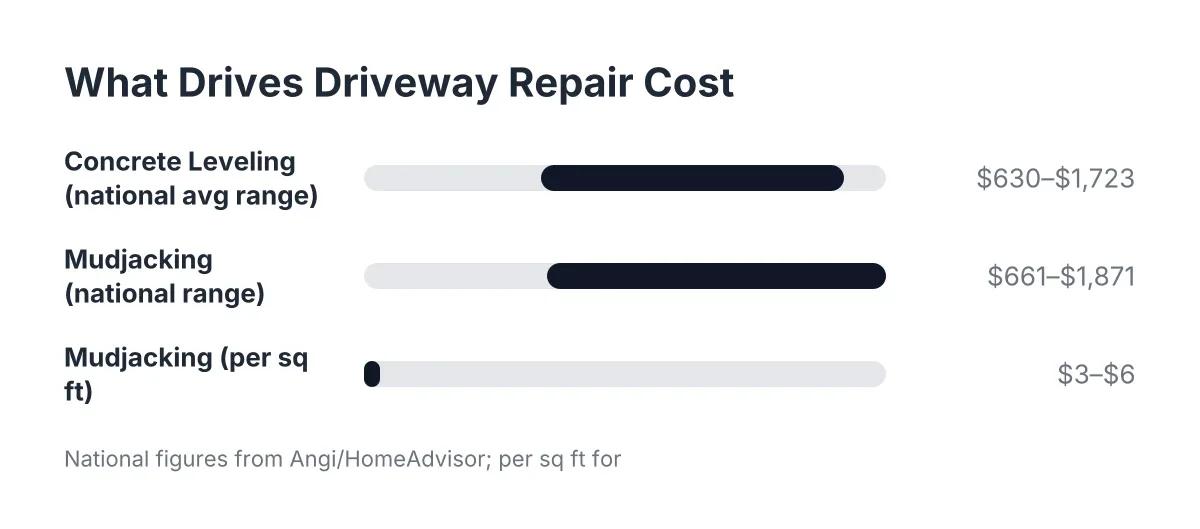
For context, the national average concrete leveling cost is $1,174, with a typical range of $630 to $1,723, according to Angi and HomeAdvisor data. Driveways often land at the higher end of that range because they're the largest slabs on most properties. A single sunken panel near the garage apron might cost a few hundred dollars to lift. However, a driveway with multiple settled sections, deep voids underneath, or a slab tilting toward the house will cost noticeably more, since each of those conditions adds labor and material.
Mudjacking specifically runs from $661 to $1,871 nationally, with most homeowners paying around $1,232, per Angi. Polyurethane foam typically costs more per job than mudjacking. That said, foam adds less weight to unstable soil and cures in minutes instead of days, which matters for driveways you need to park on quickly. In practice, this speed advantage is why many homeowners accept the higher upfront foam price.
Why Quotes Vary So Much Between Companies
If you've collected estimates, you've probably seen wide gaps between them. Some of that is method. For example, a foam-only franchise will quote foam pricing even when mudjacking would solve your problem for less money. Some of it is overhead. National networks carry franchise fees and marketing budgets that show up directly in your quote.
Beyond that, access and slab condition affect the number. A driveway with hairline cracks can usually be lifted as-is, with crack filling after the lift. In contrast, a slab broken into small, shifting pieces may not hold together during lifting, and an honest contractor will tell you that before taking your money.
For the full breakdown of pricing by scenario, including what deep voids and washout do to the number, read our guide on how much driveway leveling costs. It walks through real driveway repair cost ranges for Des Moines jobs rather than national averages alone, so you can compare your quote against local reality instead of a nationwide blend.
Leveling vs. Replacing a Sinking Driveway
This is the decision that matters most, because the price gap is enormous. Replacement means demolition, hauling, new base prep, new concrete, and weeks of cure time before you can park on it. Leveling means lifting the concrete you already own back into position, usually in a single morning.
The economics favor leveling in most cases. According to HomeAdvisor, mudjacking costs $3 to $6 per square foot and runs 25% to 50% less than replacing a concrete slab entirely. In practice, the gap on a full driveway is often even wider, because driveway replacement involves a lot of square footage and a lot of demolition work that leveling simply skips.
There's also a resale angle if you're preparing to list your home. Angi reports that concrete leveling projects can recoup 70% to 90% of their cost in added home value. A level driveway removes an obvious red flag from your listing photos and your inspection report. As a result, sellers often find leveling one of the highest-return fixes they can make before going to market, especially compared with cosmetic upgrades that buyers barely notice.
When Leveling Is the Right Call
Leveling works when the concrete itself is still sound. If your slab has settled but the panels are largely intact, lifting restores it to grade. Cracks alone don't disqualify a slab. We fill and seal cracks after the lift, and a lifted slab with sealed cracks will outperform a cracked slab left sitting on voids indefinitely.
Additionally, leveling makes sense when the problem is soil, not concrete. New-construction neighborhoods around Des Moines see this constantly. Builders backfill utility trenches and foundation excavations, and that fill settles over the first five to ten years. The concrete itself is fine. The ground under it moved, and lifting fixes exactly that without touching sound material.
When Driveway Repair Replacement Costs Make Sense
However, some driveways are past saving. If the slab has crumbled into small fragments, if the surface is badly spalled and scaling across large areas, or if the concrete was poured thin and is structurally failing, lifting broken pieces just relocates the problem. In those cases, we'll tell you replacement is the better spend, even though we don't pour driveways ourselves. Our Des Moines driveway leveling service page explains how we assess slab condition before quoting, so you know which side of the line your driveway falls on before you commit to either repair path.
How Long Driveway Leveling Lasts in Central Iowa
Cost is only half the equation. The other half is lifespan, because a cheap fix that fails within a couple of years is not actually cheap. Homeowners searching "how long does driveway leveling last" deserve a straight answer, so here it is: a properly done lift on stable soil typically lasts eight to ten years or more, and it often lasts the remaining life of the slab. The variable is not the lifting material. It's the ground underneath.
Why Des Moines Soil Is the Real Variable
Central Iowa sits on expansive clay soils. These clays swell when wet and shrink when dry, which means the ground under your driveway moves with the seasons. You can explore the soil composition under your own property through the USDA Natural Resources Conservation Service Web Soil Survey, which maps soil types across Polk, Dallas, and Warren counties.
Layered on top of that is the freeze-thaw cycle. Des Moines winters push frost deep into the ground, and every freeze-thaw swing works on the soil supporting your slab. This means the same driveway leveling job can last twice as long here with good drainage as it will with a downspout dumping water along the slab edge. Consequently, drainage often matters more than the lifting method itself.
What Actually Determines Longevity
Three factors control how long your lift holds. First, drainage: water washing under the slab created the void in the first place, so redirecting downspouts and sealing joints protects the repair. Second, the fill material and how completely it packs the void, since partial fills leave pockets that resettle over time. Third, the original cause — for example, a slab that sank because of a leaking pipe will sink again if nobody fixes the pipe.
Method matters here too. Mudjacking slurry is heavy, which is fine on firm soil but a liability on soft fill. Polyurethane foam weighs a fraction as much, so it suits driveways sitting over loose backfill. We cover which situations call for which method on our driveway leveling service page, and our cost guide explains how each method's lifespan factors into its true driveway repair cost over time. Comparing these guides side by side is often the fastest way to see why the cheapest quote isn't always the best value.
To put it simply, leveling done right, with drainage addressed, is a long-term repair in Des Moines. Leveling done as a quick patch, with water still flowing under the slab, is a temporary one at best. Ask any contractor you're considering what they'll do about the water, not just the concrete, because that answer tells you more than the price does.
Frequently Asked Questions
Does a sunken driveway always mean I need full replacement?
No. In most cases where the concrete panels are intact, lifting is the cheaper and faster fix. Replacement only becomes necessary when the slab itself has failed structurally.
Will leveling my driveway stop it from sinking again?
Leveling fixes the current settlement, but long-term success depends on addressing drainage and the original cause of the void. Without that, the same section can settle again over time.
How soon can I use my driveway after leveling?
Polyurethane foam cures within minutes, so you can typically drive on it the same day. Mudjacking needs a short curing period, often a day or so, before it can bear regular traffic.
Ready to Get Started?
If your driveway has sunk, cracked, or started tilting toward your foundation, get a straight answer before the next freeze-thaw season makes it worse. Des Moines Concrete Leveling Pros will inspect your slab, tell you plainly whether mudjacking, foam, or full replacement is the right spend, and give you a firm price with no franchise markup. Reach out today and find out exactly what fixing your driveway will cost.