Concrete Settling and Soil — Complete Guide
Foundation Problems vs Settling — The Complete Guide
If your driveway keeps sinking or your walkway cracked again after last winter, you need to understand foundation problems vs settling before you spend a dollar on repairs. The two get confused constantly, but they call for very different fixes and very different price tags. This guide explains what actually happens under Des Moines-area concrete: fill soil that never got compacted, downspouts washing out slab support, and central Iowa's freeze-thaw cycles. You will learn how to tell a true structural issue from ordinary slab settling, why concrete in new subdivisions sinks so predictably, and what to fix so the problem does not come back. By the end, you will know exactly what is happening under your slab and what to do about it.
What You'll Find in This Guide
Foundation Problems vs Settling: How to Tell Which One You Have
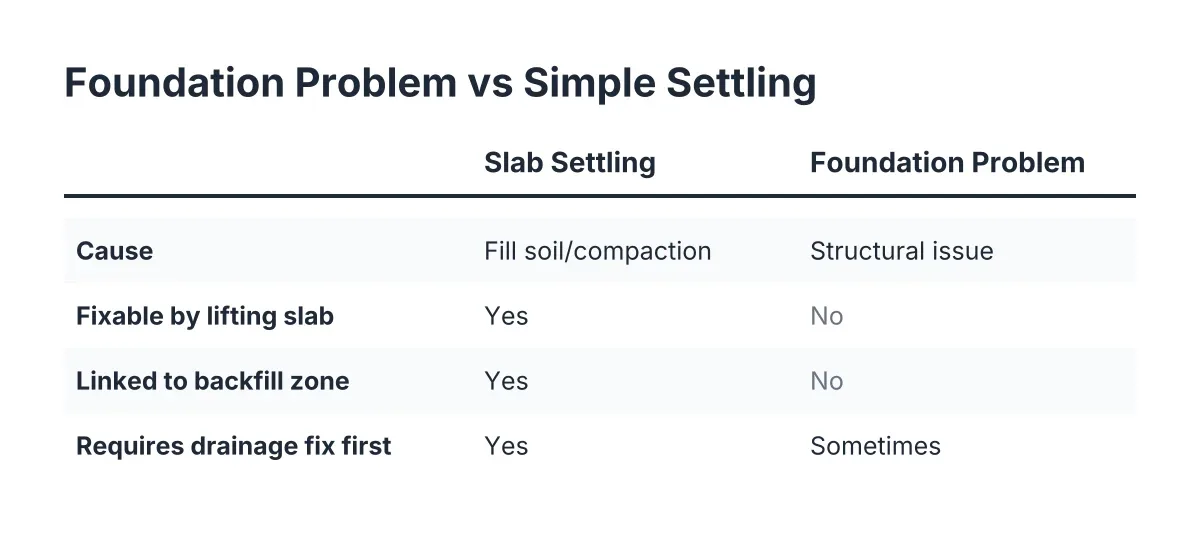
Homeowners call us every week convinced their house is failing because a sidewalk panel dropped an inch. In practice, foundation problems vs settling is usually an easy call once you know what to look for. Slab settling affects flatwork: driveways, sidewalks, patios, garage floors, and steps. These slabs sit on soil, not on footings, so they move when the soil under them moves. Foundation problems affect the structure that carries your house, which means basement walls, footings, and load-bearing elements.
The distinction matters because the fixes are worlds apart. As a result, misdiagnosing the problem can cost you thousands of dollars in unnecessary work. Slab settling gets fixed with concrete leveling, either mudjacking or polyurethane foam injection, often in a single morning. True foundation repair involves piers, wall anchors, or excavation, and it belongs to a different kind of contractor entirely. Learning to separate foundation problems from settling early saves homeowners both money and stress down the road.
Signs That Point to Slab Settling, Not Foundation Failure
Look at what moved and what stayed put. If your driveway sank but your basement walls show no new cracks, you have a settling slab. Similarly, a walkway panel that dropped at one joint while the house sits level is a soil problem under flatwork. Trip hazards at sidewalk joints, a garage floor that slopes toward one corner, and steps pulling away from the stoop all fit the settling pattern.
However, some signs deserve a closer look. Horizontal cracks in basement walls, doors that suddenly stick throughout the house, or stair-step cracking in brick or block walls suggest structural movement. In that case, get a structural evaluation before anyone lifts anything. We tell homeowners this plainly because we are a leveling specialist, not a foundation company, and pretending otherwise helps nobody. Comparing foundation problems vs settling this way, symptom by symptom, keeps the diagnosis simple and honest.
Why the Franchise Answer Falls Short
National franchise networks often blur this line on purpose. Their templated Des Moines pages funnel every crack toward the most expensive structural solution. To put it simply, a sunken patio slab does not need helical piers. It needs the void under it filled and the slab lifted back to grade. If you want to know what that actually costs here, our concrete settling and soil cost guide walks through real numbers. For context, HomeAdvisor data shows mudjacking runs 25% to 50% less than replacing a slab entirely, which is exactly the kind of savings that gets buried when everything gets treated as a structural emergency.
Why New Subdivision Concrete in Des Moines Keeps Sinking
If you bought a home in Waukee, Ankeny, Grimes, or Norwalk in the last ten years, your concrete sits on disturbed ground. Builders excavate for the basement, then push that soil back around the foundation as backfill. Additionally, graders cut and fill across the whole lot to create the final elevation. Every yard of that moved soil is fill soil, and fill soil settles.
Here is the mechanism. Undisturbed central Iowa soil compacted naturally over thousands of years. Once excavation loosens it, the soil holds far more air. Even with mechanical compaction, backfill rarely reaches the density of native ground. Over the next several years, gravity, moisture, and traffic squeeze that air out. The soil consolidates, drops, and takes your driveway, walkway, or garage floor down with it. This is why so many homeowners search "why does concrete keep sinking" a few years after closing on a new build. It also explains why so many new-construction warranty calls end up being soil issues rather than concrete defects.
The Backfill Zone Around Your Foundation
The worst settling happens in a predictable band. That band is the backfill zone, roughly the first several feet out from your foundation wall. Consequently, the concrete most likely to sink is the concrete closest to the house: front stoops, steps, the first driveway panel at the garage, and walkways that hug the foundation. If your steps tilted toward the house or your stoop dropped away from the door threshold, you are looking at classic backfill consolidation.
Central Iowa adds its own twist. Much of the Des Moines metro sits on expansive clay soils that swell when wet and shrink when dry. According to the USDA Natural Resources Conservation Service, soil survey data for this region shows clay-heavy profiles across most of the metro. In practice, that means your fill soil does not just consolidate once and stop. It keeps cycling with the seasons, expanding in wet springs and shrinking in dry Augusts, which opens voids under slabs year after year. This seasonal cycling is a big part of why the same slab can need attention more than once over a decade.
Why Leveling Alone Is Not Always the Whole Answer
With this in mind, understand what leveling does and does not do. Lifting a slab fills the void and restores the surface to grade. However, if a downspout keeps dumping water into the backfill zone, the soil will keep moving. That is why a good leveling contractor looks at the soil and drainage picture, not just the slab. The cost guide explains how soil condition changes the repair approach and the price, and it is worth reading before you commit to any single quote.
Drainage, Downspouts, and Freeze-Thaw: The Water Problem Under Your Slab
Soil compaction explains why concrete starts sinking. Water explains why it keeps sinking. Nearly every repeat-settling case we see in the Des Moines metro traces back to water moving where it should not, so this is the section to read twice.
Start with your downspouts. A single downspout can discharge hundreds of gallons during one Iowa thunderstorm. If that water lands next to a slab, it does two things. First, it saturates the soil, which softens clay and accelerates consolidation. Second, it erodes fine soil particles out from under the slab edge, carving voids that grow with every storm. A downspout causing sunken concrete is one of the most common patterns we diagnose, and it is also one of the cheapest to fix. Extend the discharge at least five to ten feet past the slab, and you remove the engine driving the settlement.
How Freeze-Thaw Cycles Break and Sink Central Iowa Concrete
Des Moines winters swing above and below freezing dozens of times a season. Each swing works on your concrete two ways. On the surface, water enters small cracks, freezes, expands, and pries the cracks wider. That is freeze-thaw concrete damage, and it is why crack filling matters even on slabs that have not sunk. Below the surface, saturated soil freezes and heaves the slab upward. Then the thaw comes, the soil turns soft, and the slab drops back down, often lower than it started. Repeat that cycle thirty times a winter, and a stable slab becomes an uneven one.
Beyond that, grading matters as much as downspouts. Soil around a house should slope away from the foundation. On new lots, backfill consolidation often reverses that slope within a few years, creating a shallow trough that funnels roof water straight into the backfill zone. As a result, the slabs nearest the house get a double dose: settling fill underneath and concentrated water on top. Homeowners who fix the grading alongside the slab tend to see the longest-lasting results.
Pairing Drainage Fixes With Leveling
The fix that lasts pairs the lift with the water correction. Level the slab, seal the cracks and joints so surface water sheds instead of soaking in, and redirect the downspouts. For example, a sunken front walkway we lift without touching a nearby downspout will likely settle again within a few seasons. Handle both, and the repair holds. The good news is that this pairing stays affordable. Angi and HomeAdvisor data puts the national average concrete leveling cost at $1,174, and Angi reports these projects can recoup 70% to 90% of their cost in home value. That said, your number depends on your soil, which is exactly what our settling and soil cost guide breaks down.
Putting It All Together
Understanding foundation problems vs settling, and then understanding the water underneath it all, puts you ahead of most homeowners and, frankly, ahead of the templated advice the national franchises publish for every city they operate in. Once you know which category your slab falls into, and once you know what is driving the soil movement beneath it, you can ask a contractor the right questions instead of accepting the first estimate you get. That single piece of knowledge, more than any tool or technique, is what separates a lasting repair from one you will pay for again in a few years.
Ready to Get Started?
If your driveway, walkway, patio, or steps have sunk, you now know why, and you know the fix does not have to mean full replacement or structural repair. Des Moines Concrete Leveling Pros will look at your slabs, your soil, and your drainage, then tell you plainly whether mudjacking or polyurethane foam fits your situation. Reach out for an honest, local assessment from a team that levels concrete for a living, right here in the Des Moines metro.