Sunken Slab Repair — Complete Guide
If your driveway dips at the garage door or your patio slopes toward the house, you need a clear picture of sunken slab repair before you call anyone. This guide explains why concrete sinks in the Des Moines metro, what a proper repair looks like, and what it costs. You will learn how central Iowa's clay soils and drainage patterns create the voids under your slab, and why the fix starts with the soil, not the concrete. By the end, you will know which sunken slab repair method fits your slab, what timeline to expect, and whether insurance might help.
What You'll Find in This Guide
Coming soon — we're building out this topic cluster.
Prefer to have a pro handle it? Sunken slab repair is one call away.
Why Is My Concrete Sinking? The Soil Story Under Des Moines Slabs
Concrete rarely fails on its own. Instead, the ground beneath it gives way, and the slab follows. To put it simply, sunken slab repair is really a soil problem wearing a concrete disguise. Once you understand what happened under the slab, the right fix becomes obvious. Three culprits explain nearly every case in the Des Moines metro:
- Expansive clay that swells and shrinks with the seasons
- Poor compaction beneath newer driveways and patios
- Erosion caused by water that washes soil out from under the slab
Each of these deserves a closer look, because the cause determines which repair actually holds.
Expansive Clay and the Freeze-Thaw Cycle
Central Iowa sits on soils with a high clay content. Clay swells when it absorbs water and shrinks as it dries. As a result, the ground under your slab moves up and down through every wet spring and dry August. Over years, that movement opens gaps beneath the concrete. Winter makes it worse. Water in the soil freezes, expands, and heaves the slab. Then the thaw arrives, the soil collapses back down, and the slab settles into the void unevenly. You can explore the soil types under your own lot using the USDA Web Soil Survey, which maps soil composition parcel by parcel.
Poor Compaction in Newer Subdivisions
If you bought in a newer Des Moines subdivision, your sinking slab may trace back to construction day. Builders often backfill around foundations and under flatwork with loose fill soil. When crews compact that fill poorly, or rush the schedule, the soil keeps settling for five to ten years after the pour. This means that a driveway poured on fill can look perfect at closing and drop two inches by the time your kids start school. New-construction settling follows a predictable pattern: the slab sections closest to the foundation sink first, because that backfill zone is deepest.
Erosion and Drainage Failures
Water is the third culprit, and often the fastest one. A downspout that dumps next to the driveway, a negative grade that sends runoff under the patio, or a leaking irrigation line can wash soil out from under a slab in a single season. Consequently, you end up with a void under the concrete slab even when the surrounding soil is stable. Voids are dangerous because the slab may look fine while it spans an empty pocket. Eventually, a car tire or a heavy freeze cracks it through. If your slab sounds hollow when you tap it, or if cracks appear near a downspout, erosion is the likely cause. Fix the water first, because any leveling repair will fail again without that step.
How Sunken Slab Repair Works: Lifting, Not Replacing
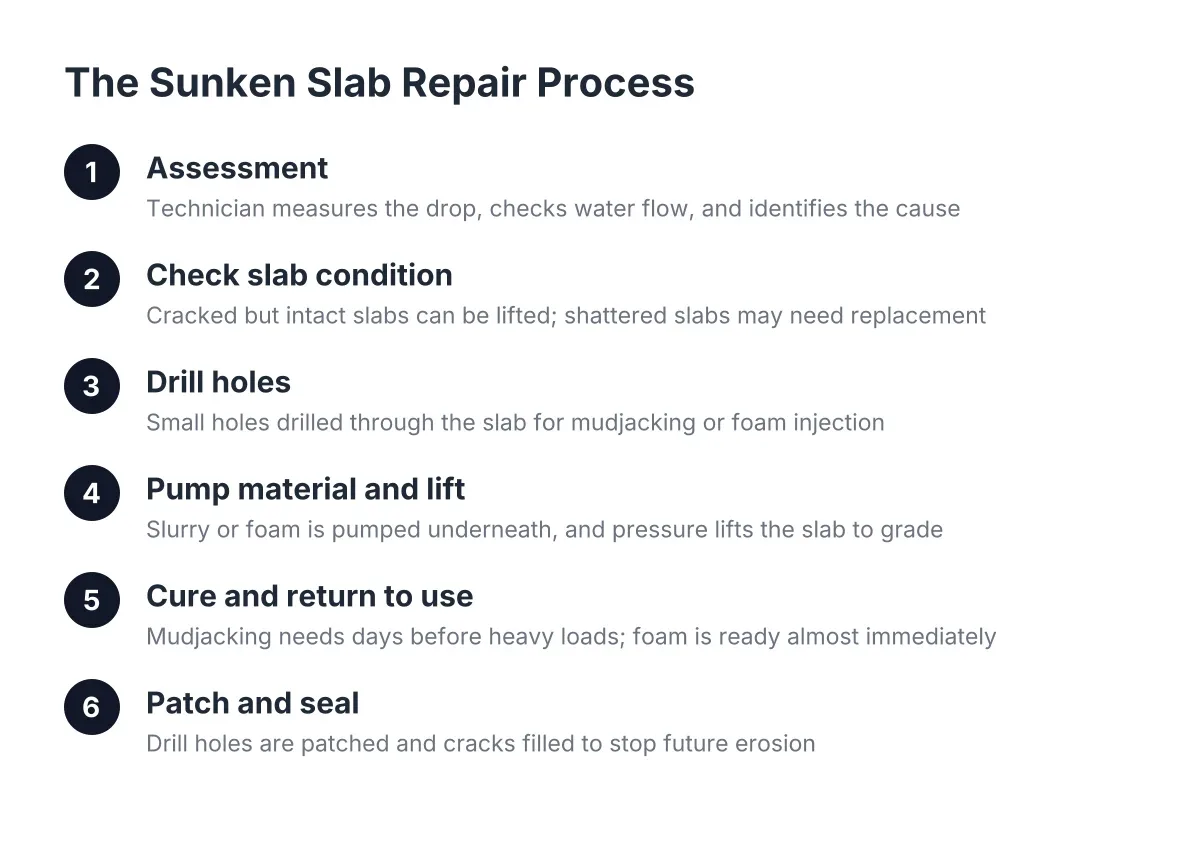
Most homeowners assume a sunken slab means tear-out and replacement. In practice, that is usually the most expensive and least necessary option. If the concrete itself is sound, you can lift the existing slab back to grade by filling the void beneath it. Two methods dominate this type of concrete slab repair, and each has a clear place depending on the slab and the soil underneath it.
Mudjacking: The Heavy-Duty Workhorse
Mudjacking pumps a slurry of sand, cement, and soil through small holes drilled in the slab. The slurry fills the void and hydraulically raises the concrete. Because the material is dense, mudjacking works well for heavier slabs and larger lifts, like a driveway approach that has dropped several inches. According to HomeAdvisor, mudjacking runs 25% to 50% less than replacing a concrete slab entirely. That gap matters when you are comparing a one-day lift against a week of demolition, forming, pouring, and curing. The tradeoff is weight. Mudjacking slurry adds load to the soil below, so it is not the right choice over soft or still-settling fill.
Polyurethane Foam Injection: Light, Fast, Precise
Polyurethane foam injection uses smaller holes, roughly the size of a penny, and injects an expanding foam that lifts the slab in controlled increments. The foam weighs a fraction of cement slurry, so it will not add settlement pressure to weak fill soils common in newer subdivisions. Additionally, foam cures in minutes rather than days, which means you can drive on the slab the same afternoon. For sidewalks, patios, and garage floors where precision matters, foam often wins. However, it typically costs more per job than mudjacking, so the right answer depends on your slab condition, the load it carries, and the soil beneath it.
How to Choose Between Them
A specialist should walk you through the decision, not push one method because it is the only one they sell. That is a real difference between a local concrete-leveling company and the franchise networks. Before you commit to either method, ask three questions:
- How much does the slab weigh, and how thick is the concrete?
- What actually caused the void — clay movement, poor compaction, or erosion?
- How fast do you need to use the surface again?
For example, a sunken patio over eroded soil with a fixed drainage problem is a strong foam candidate. Meanwhile, a thick driveway slab that dropped uniformly over stable clay may lift better and cheaper with mudjacking. The honest answer changes house to house, which is why templated advice from national brands often misses the mark.
Cost, Timeline, and the Insurance Question
Once you know why your slab sank and how a lift works, the practical questions remain. What does sunken slab repair cost, how long does the work take, and will your homeowners policy help pay for it?
What Homeowners Actually Pay
Nationally, mudjacking costs land in a fairly tight range. According to Angi, the national average runs from $661 to $1,871, with most homeowners paying around $1,232. Small jobs still carry a floor, though. Angi also notes that minimal projects may hit a minimum charge of about $500, even when the affected area is under 100 square feet. That said, leveling remains dramatically cheaper than tear-out. Beyond the repair bill itself, the work holds value. Angi reports that mudjacking and concrete leveling projects can recoup 70% to 90% of their cost in added home value. In other words, fixing a sunken driveway before listing your home usually pays for most of itself.
Timeline: Faster Than You Expect
Most residential leveling jobs finish in a single visit. A typical driveway or patio lift takes two to four hours from setup to cleanup. With mudjacking, you should keep vehicles off the slab for one to three days while the slurry cures. With polyurethane foam, the cure happens in minutes, so light use resumes almost immediately. Compare that to replacement, which can put your driveway out of service for a week or more while new concrete cures. For most Des Moines homeowners, the schedule alone settles the debate in favor of leveling over replacement.
Will Insurance Cover a Sunken Slab?
This is the question insurance-minded homeowners ask first, and the honest answer is: usually no, but not always. Standard homeowners policies exclude damage from soil settling, poor compaction, and gradual erosion, because insurers treat these as maintenance issues rather than sudden losses. However, exceptions exist. If a covered peril caused the void, such as a burst supply line washing out the soil, the resulting slab damage may qualify for a claim. Before you file, take a few concrete steps to protect your case:
- Photograph the slab from multiple angles and note the date
- Record when the sinking started and how it has progressed
- Identify the water source if one exists, such as a leaking pipe or downspout
- Read your policy's earth movement and water damage exclusions carefully
A claim built on "my driveway settled over ten years" will fail. A claim built on "a plumbing failure eroded the soil in March" has a real chance. Either way, get a repair estimate first, so you know whether the cost even exceeds your deductible.
Ready to Get Started?
If your driveway, patio, or walkway is sinking, the problem will not fix itself, and every freeze-thaw cycle makes the void underneath a little bigger. Des Moines Concrete Leveling Pros will assess your slab, explain the soil cause in plain language, and tell you honestly whether mudjacking or foam fits your situation. This kind of straightforward, method-agnostic sunken slab repair evaluation is exactly what separates a trustworthy local contractor from a one-size-fits-all franchise pitch. Reach out for a straightforward evaluation and get your concrete back to level before the next Iowa winter does more damage.