Sidewalk Leveling Near Me: 7 Questions to Ask Before You Hire Anyone
A sunken sidewalk panel is not just ugly. It is a tripping hazard that can hurt your kid, your mail carrier, or your mother-in-law on Thanksgiving. If you are searching for sidewalk leveling near me, you have probably already stubbed a toe or watched a neighbor catch an edge. The good news is that sidewalk concrete repair is usually a one-day fix, and it costs far less than tearing out the slab. The hard part is picking the right local contractor and asking the questions that separate a specialist from a sales pitch. This guide walks you through that, step by step.
Here in Des Moines, our expansive clay soils and freeze-thaw winters make sidewalks sink more often than homeowners expect. So the question is rarely whether your walkway will settle. It is what you do when it does.
Step 1: Measure the Trip Hazard Before You Call
Grab a tape measure and check the height difference between the sunken panel and the one next to it. Many cities flag a sidewalk edge of about half an inch or more as a trip hazard. If you can catch the edge with the toe of your shoe, it can catch a person walking at night.
Write down what you find. Note which panels are sunken, how far they have dropped, and whether the concrete is cracked or just tilted. Take photos from a few angles with something for scale, like a tape measure or a soda can.
This matters for two reasons. First, it tells you how urgent the fix is for safety. Second, if you plan to talk to your insurance company, dated photos and measurements are the documentation an adjuster will ask for.
Step 2: Find Out Who Is Responsible for the Sidewalk
In Des Moines and most surrounding communities, the homeowner is typically responsible for maintaining the public sidewalk that borders their property, even though the city owns the right of way. That surprises people. If someone trips on the sidewalk in front of your house and gets hurt, the liability question can land on you.
Therefore, check with your city before you assume anything. Some central Iowa cities run sidewalk inspection programs and will send you a repair notice. Others offer cost-sharing programs for sidewalk concrete repair in the public right of way. A five-minute call to your city's public works office can save you from paying for something the city would have split with you.
If the walkway is entirely on your property, from your driveway to your front door, the responsibility is clearly yours. That also means the fix is yours to schedule on your timeline, before winter or before a home sale, instead of on the city's.
Step 3: Know What Insurance Will and Will Not Cover
Standard homeowners insurance usually does not cover normal settling. Settling from clay soil movement and freeze-thaw cycles is treated as gradual wear, not a sudden covered event. However, if a specific event caused the damage, like a water line break washing out soil under the slab, part of the repair may be covered.
Do not guess. Call your agent and describe exactly what happened and when. Use plain terms: sunken sidewalk, settling, uneven concrete. Ask whether the cause matters for your policy and what documentation they need.
Then get a written estimate from a local contractor that describes the problem, the likely cause, and the repair method. An adjuster can work with a clear, itemized estimate. A vague one-line quote helps nobody. Even if the claim is denied, you will have the paperwork done and a real number in hand, so you are not stuck starting over.
Step 4: Understand Your Repair Options Before Estimates Arrive
You will hear several terms when you start calling around. Here is what they mean in plain language:
- Concrete leveling (also called slab jacking or concrete lifting): A crew drills small holes in the sunken slab, pumps material underneath to raise it, and patches the holes. According to Wikipedia, the patched holes are finished to closely match the original surface. Mudjacking uses a cement slurry; polyurethane foam injection uses expanding foam. Both lift the existing concrete back into place.
- Grinding: Shaving down the raised edge. Cheap, but it removes concrete and does nothing about why the slab sank.
- Resurfacing or patching: A thin overlay or crack filling on top. Useful for surface damage, but outdoor patches over a still-sinking slab tend not to hold up long.
- Full replacement: Tear out and repour. The right call for badly shattered concrete or slabs heaved by tree roots, but the most expensive option by a wide margin.
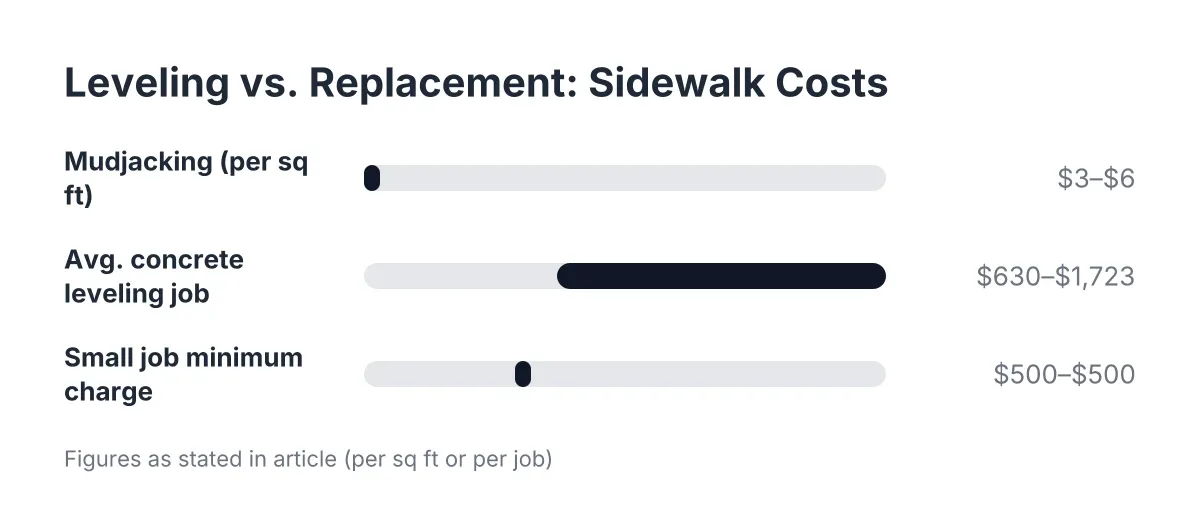
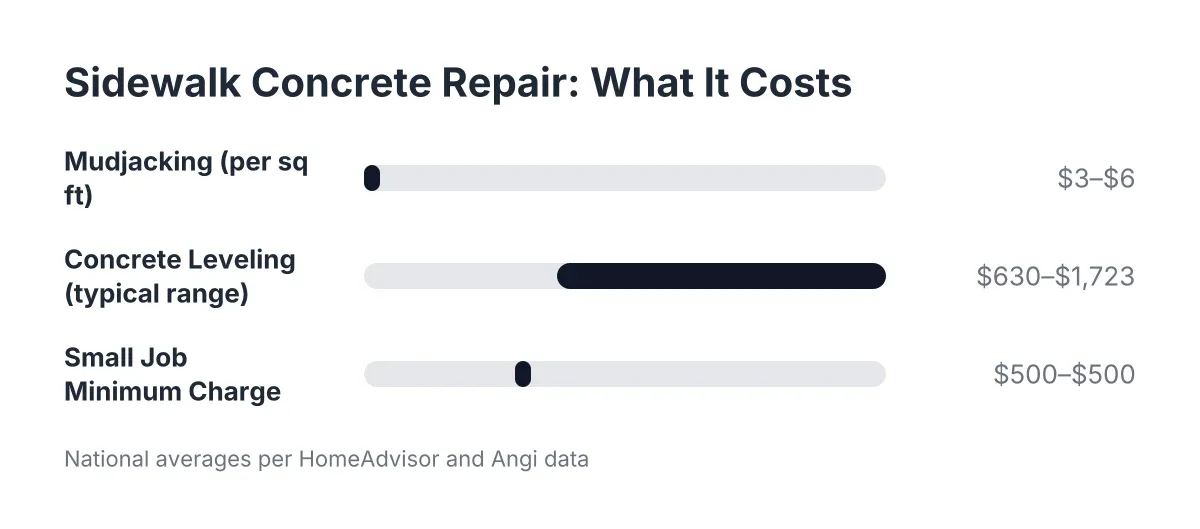
For a sunken but structurally sound walkway, leveling is usually the best value. According to HomeAdvisor, mudjacking runs $3 to $6 per square foot and costs 25% to 50% less than replacing the slab entirely. Angi and HomeAdvisor data put the national average concrete leveling cost at $1,174, with a typical range of $630 to $1,723. Keep in mind that small jobs may carry a minimum charge of about $500, according to Angi, so a single panel and a three-panel job can price closer together than you would expect.
One honest limitation: leveling cannot fix concrete that is crumbling, badly shattered, or lifted by a large tree root. In those cases, cutting out and replacing the affected panel is the better long-term fix, and a trustworthy contractor will tell you so.
Step 5: Ask These Questions During the Sidewalk Concrete Repair Estimate
This is where you separate a specialist from a template pitch. When the estimator is standing on your walkway, ask:
- Mudjacking or foam, and why for my slab? A good answer covers your slab's condition, the load it carries, cure time, and cost. A bad answer is "we only do one method" with no reasoning.
- What made this panel sink? In central Iowa, the usual suspects are clay soil shrinking in drought, washout from a downspout, and freeze-thaw movement. If they cannot name a cause, they cannot prevent a repeat.
- Will you level the adjoining panels too? Lifting only the obviously sunken slab can create a new tripping hazard where the raised panel meets its neighbor. A settlement repair often needs to include the panels on either side.
- What does the written estimate include? Ask for an itemized estimate that names the repair method, the panels involved, and any crack filling or joint sealing. That is the document your adjuster, or a future home buyer, will want to see.
- Can you look at the rest of my concrete while you are here? A walkthrough of your driveway, steps, and patio costs the contractor nothing and can catch a slab that is starting to settle before it becomes the next hazard.
- How do I keep this from sinking again? Listen for downspout extensions, gutter fixes, and soil grading. If they skip this, they are selling a lift, not a lasting repair.
- What can't you fix? The honest ones will point at a shattered corner and say that piece needs patching or replacement, not lifting.
Get at least two estimates and compare the answers, not just the prices. The cheaper bid that skips the adjoining panels is not actually cheaper once you pay someone to come back.
Step 6: Compare Sidewalk Concrete Repair Costs Against Replacement
Say a Des Moines homeowner has three sunken panels along the front walk, each dropped about an inch after a wet spring followed by a hard freeze. In that hypothetical scenario, leveling might land somewhere in the range of a few hundred dollars to around $1,500 depending on access and material, while tearing out and repouring those same panels could cost double or more, plus days of waiting while new concrete cures. Those are illustrative estimates, not quotes; your written estimate is the real number.
In addition, leveling is not money thrown away. According to Angi, mudjacking and concrete leveling projects can recoup 70% to 90% of their cost in added home value. For anyone leveling a walkway before selling a house, that math matters, because an inspector or buyer's agent will flag an uneven walkway every time.
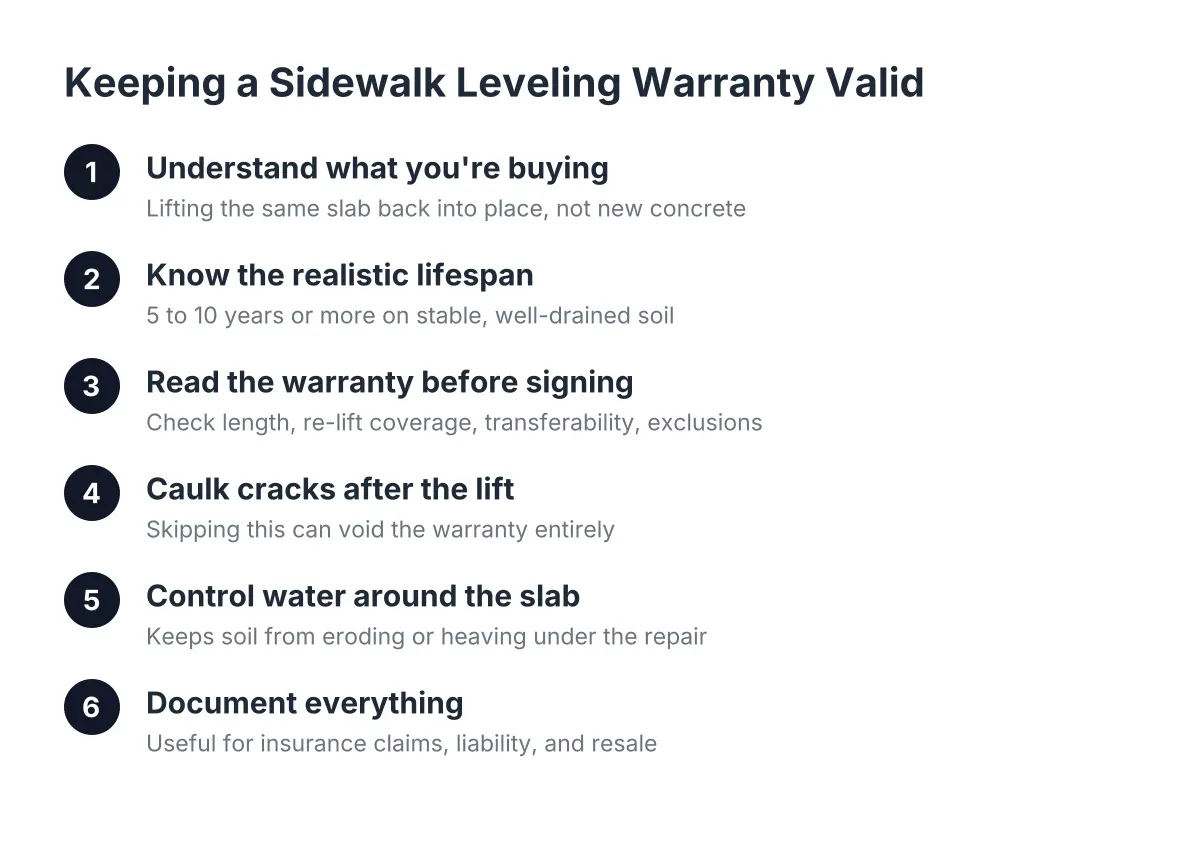
Be aware that extras can push a job above the base price. Crack repair, joint sealing, and sealing the slab edges add cost, but they also keep water from washing out the soil you just stabilized. Ask for these as line items so you can decide.
Step 7: Protect the Repair So You Never Pay Twice
A leveled sidewalk stays level only if the soil under it stays put. After the crew leaves, the maintenance is on you, and it is simple:
- Extend downspouts so roof water discharges away from the walkway, not beside it.
- Fix leaking or overflowing gutters before the next freeze.
- Grade soil and mulch beds so water drains away from the concrete.
- Fill small cracks early so water cannot reach the soil below. For large cracks in concrete, a flexible polyurethane sealant or a sand-and-sealant fill works better outdoors than rigid patch; rigid fills tend to pop out with freeze-thaw movement.
- Watch for chipmunk or vole tunnels along slab edges and deal with them early.
As a result, the same clay soil and freeze-thaw cycle that sank your sidewalk the first time has a much harder time doing it again.
The Bottom Line for Des Moines Homeowners
Sidewalk and walkway leveling is one of the few home repairs where the fast option and the right option are usually the same thing. Measure the hazard, confirm who is responsible, call your insurance agent before you assume anything, and then make local contractors answer specific questions about method, cause, and adjoining panels.
The contractor worth hiring is the one who explains why your sidewalk sank, tells you plainly when leveling is not the answer, and hands you a written estimate detailed enough to put in front of an adjuster. In a metro where clay soil guarantees some concrete will settle, that kind of straight answer is worth more than any sales pitch.
If you need concrete leveling, Des Moines Concrete Leveling Pros can help.
Prefer to talk it through? Call +15155828701 — a quick call is usually the fastest way to get a straight answer for your situation.