How Long Does Sidewalk Leveling Last? Warranty and Maintenance Reality
If you have a sunken sidewalk slab and a tripping hazard waiting for someone to find it, you want a repair that holds. So how long does sidewalk leveling actually last? The honest answer: often 5 to 10 years or more, and sometimes much longer, but only when the repair is done right and the homeowner handles a few simple maintenance tasks afterward. Understanding what a sidewalk leveling warranty covers is that second part, which most service pages skip, and it is exactly where sidewalk leveling warranties live or die.
This guide walks you through the lifespan question step by step. It covers what shortens a repair's life, what a real warranty covers, and the specific maintenance steps that keep a leveled sidewalk level. If you are a landlord worried about a tenant falling, or a homeowner trying to document a repair for an insurance claim, this is the part of the decision that matters most.
Step 1: Understand What You Are Actually Buying
Before you compare quotes, know what sidewalk leveling is. A crew drills small holes in the sunken slab, pumps a lifting material underneath to raise and stabilize it, then patches the holes so they closely match the original surface, according to Wikipedia. The two common materials are a cement slurry (mudjacking, also called slab jacking) and polyurethane foam.
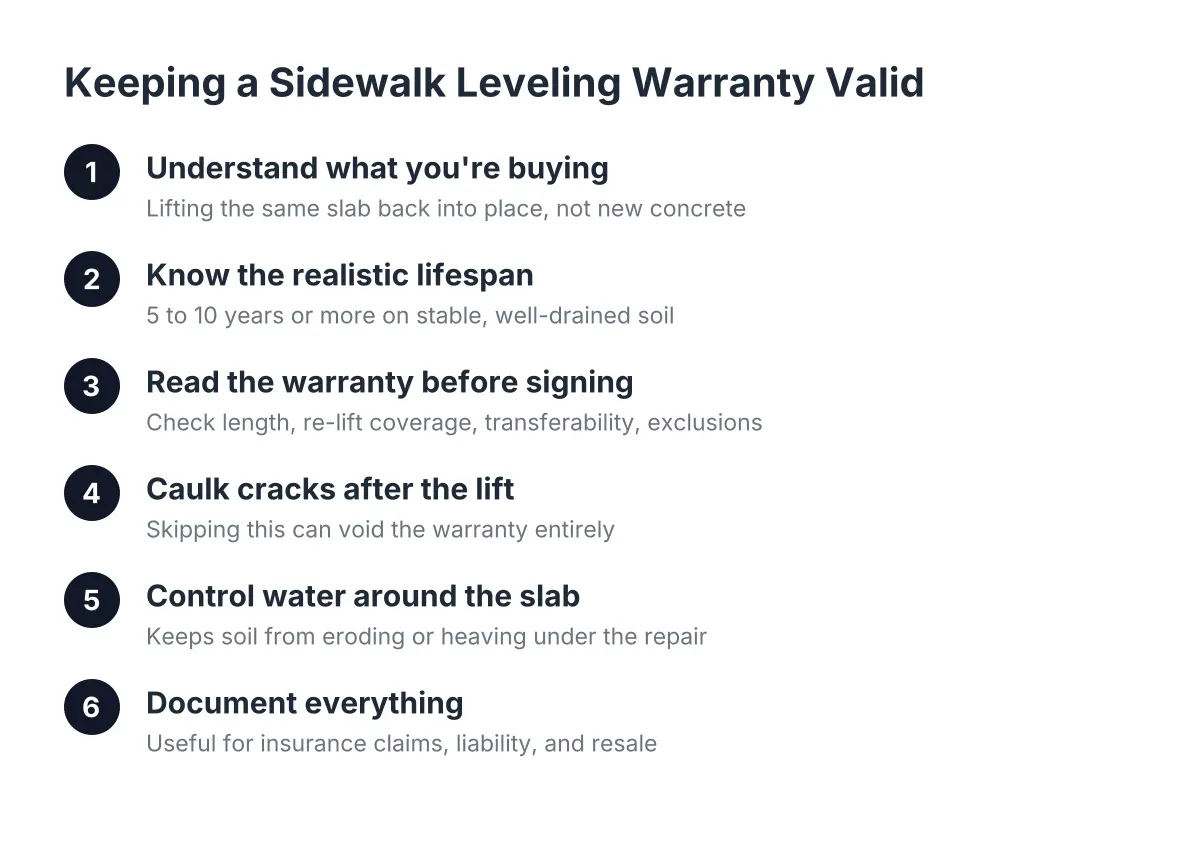
You are not buying new concrete. You are buying the same slab, lifted back into place and supported. That matters for lifespan: the repair is only as durable as the slab itself and the soil under it. A sound slab with one sunken corner is a great candidate. A slab crumbling into five pieces is not, and a straight answer from a contractor should tell you which one you have.
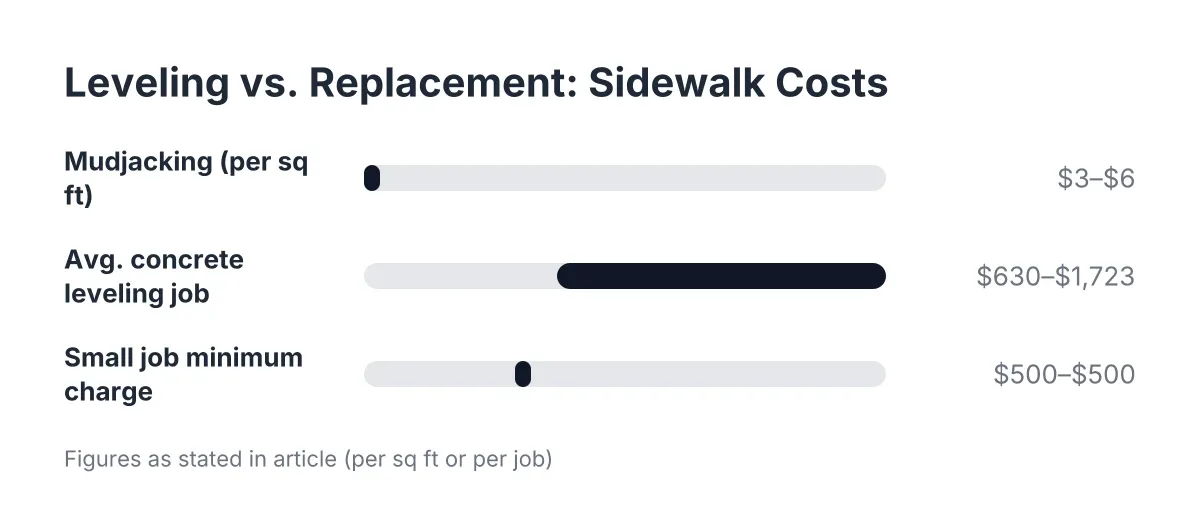
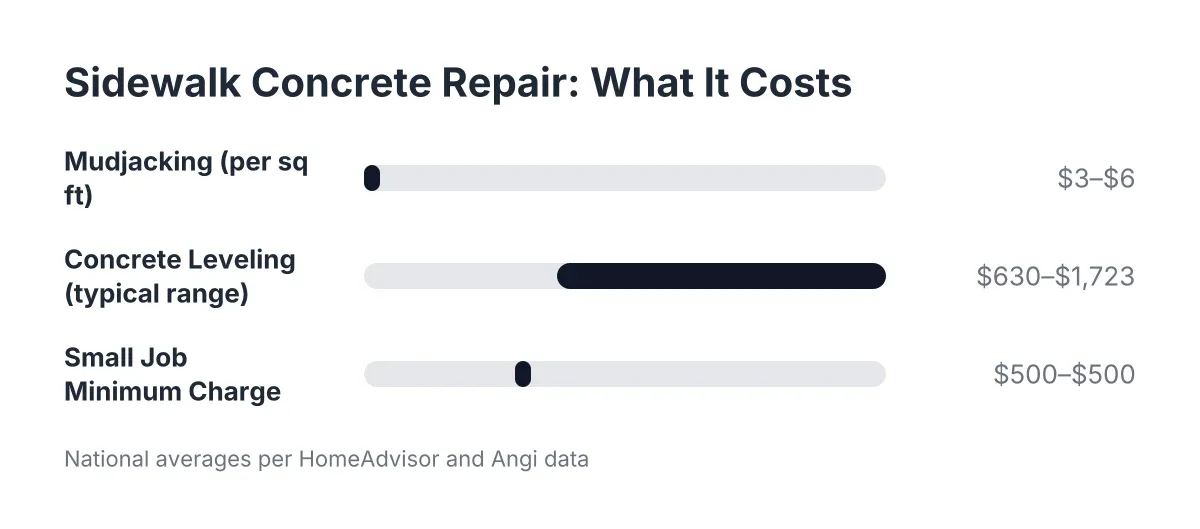
Cost is part of the comparison too. The national average concrete leveling cost is $1,174, with a typical range of $630 to $1,723, according to Angi and HomeAdvisor data. Mudjacking runs 25% to 50% less than replacing a concrete slab entirely, according to HomeAdvisor. That gap is why leveling usually beats pouring new sidewalk concrete when the slab is still in good shape, since a new concrete walkway costs more and takes days to cure instead of hours.
Step 2: What to Expect from Sidewalk Leveling Warranty Coverage in Central Iowa
How long does sidewalk leveling last? A well-done repair on stable soil commonly lasts 5 to 10 years, and many last far longer. However, no honest contractor promises forever. Concrete can settle again from natural soil movement or causes nobody could see at the time of the repair, even when everything was done right.
Des Moines adds its own wrinkle. Central Iowa sits on expansive clay soil that swells when wet and shrinks when dry. Add freeze-thaw cycles each winter, and the ground under your walkway moves more than ground in milder climates. That movement is why the same slab that sank once can sink again if water keeps reaching the soil beneath it.
The material matters less than the water. Mudjacking slurry and polyurethane foam both hold up for years under a residential sidewalk. What fails is usually not the lifting material; it is the soil washing out or compressing underneath it. So when someone asks how long concrete leveling foam lasts, the better question is how long the soil under the slab stays dry and packed.
One more timing note. Foam cures within hours, so the walkway is usable the same day. Mudjacking slurry needs a day or so before heavy loads. Either way, the question of how long concrete leveling takes to dry is measured in hours and days, not weeks.
Step 3: Read the Warranty Before You Sign Anything
Reputable concrete leveling companies put a warranty in writing that covers both materials and workmanship. Ask for it before work starts, not after. Then read the conditions, because many warranties require ongoing maintenance to stay valid.
Here is what to look for in any warranty covering your sidewalk leveling:
- Length and scope. How many years, and does it cover re-lifting if the slab settles again, or only the material?
- Maintenance conditions. Many warranties require you to caulk cracks and joints after the repair. Skipping that caulking can void the warranty entirely.
- Transferability. If you sell the house or the rental, does the warranty follow the property? This matters for pre-listing repairs.
- Exclusions. Tree roots, plumbing leaks under the slab, and new construction nearby are common carve-outs.
For the insurance-minded reader, that written warranty doubles as documentation. If your adjuster asked for an estimate or an inspection report, a detailed written scope with warranty terms is far more useful in a claim file than a verbal quote. Be aware, though, that standard homeowner policies treat gradual settling differently than sudden storm damage, and coverage decisions rest with your insurer, not your contractor. A plainly written estimate just makes sure the paperwork question never falls on you.
Step 4: Caulk the Cracks, or Risk Voiding the Warranty
This is the single most skipped step, and it is the one that costs people the most. After a slab is lifted, the cracks and joints need to be sealed with flexible caulk. Crack filling keeps rain and snowmelt from running through the slab and into the soil below, where it erodes the base and restarts the settling.
Many providers will not honor a warranty on the repair without that caulking. It sounds like a small detail. It is not. An unsealed crack in a Des Moines sidewalk takes on water every spring thaw, and that water either washes soil away or freezes and heaves the slab. Either way, your repair's life gets cut short and your warranty may already be void.
If your contractor includes crack repair and joint sealing in the quote, good. If not, ask why, and get it done anyway.
Step 5: Control the Water Around the Slab
Water is the main reason a leveled sidewalk sinks again. Therefore, the maintenance that extends a repair is mostly drainage work you can do yourself in an afternoon:
- Route downspouts away from the walkway, at least several feet past the slab edge.
- Fix leaky or overflowing gutters so water does not sheet onto the concrete every storm.
- Grade the soil beside the walkway so rain runs away from the slab, not under it.
- Keep soil backfill in place along the slab edges; replace any that washes out.
- Watch for burrowing pests like chipmunks and voles that tunnel under slabs and create voids.
For a small landlord, this checklist fits neatly into a seasonal walkthrough. Suppose you own three rentals on the south side and a tenant reports a raised sidewalk joint at one of them. You schedule the leveling, then add the five items above to your fall and spring inspection list across all three properties. That ten-minute check per property is what keeps a $600 repair from becoming a repeat repair, and it shrinks your liability exposure on every unit at once.
Step 6: Match the Fix to the Cause, Especially Tree Roots
Leveling fixes settling. It does not fix an active cause that keeps pushing or pulling the slab. The big one on sidewalks is tree roots. If a root lifted the slab, the lasting fix is usually to saw-cut the root area and replace that section, though that is not always practical when the tree is healthy or sits on city property.
Likewise, if a section of walkway needs a ramped patch between uneven slabs, the geometry matters. A longer, consistent slope is safer than a short, abrupt one; a steep patch can become its own tripping hazard. Most residential sidewalk repairs are modest, a few small sections or a corner and a single resurfacing pass, so do not let anyone sell you a full-walkway overhaul when one slab moved.
This is also where a professional assessment earns its keep. If the slab is badly cracked, if roots are active, or if a plumbing leak may be eroding the soil, leveling alone will not hold, and an honest contractor should say so before taking your money.
Step 7: Document Everything for Insurance, Liability, and Resale
Whether the trigger was heavy spring rain, a freeze-thaw cycle, or a tenant complaint, paper protects you. Keep the written estimate, the invoice describing the work, photos from before and after, and the warranty terms in one file.
That file serves three jobs. First, if you are filing a claim, your adjuster gets a clear scope and cost instead of a vague phone quote. Second, if someone trips on your walkway later, dated records showing you repaired a known hazard promptly are your best defense. Third, if you sell, leveling work holds its value; concrete leveling projects can recoup 70% to 90% of their cost in added home value, according to Angi, and a transferable warranty sweetens the disclosure.
In Des Moines, like many cities, the homeowner often bears responsibility for the public sidewalk fronting the property, so check your city's sidewalk program before assuming a raised panel is someone else's problem.
The Bottom Line on How Long Sidewalk Leveling Warranty Coverage Holds Up
A properly done sidewalk and walkway leveling job, with cracks caulked and water routed away, routinely delivers years of level, safe concrete at a fraction of replacement cost. The lifespan question is less about the lifting material and more about the three things you control: sealing, drainage, and catching small movement early.
No repair on central Iowa clay is guaranteed forever, and anyone who promises otherwise is selling, not explaining. But between a written warranty, an afternoon of drainage fixes, and a quick look at the caulk lines each spring, you can push a leveling repair toward the long end of its range and keep the tripping hazard, the liability worry, and the repeat bill off your plate.
If you need concrete leveling, Des Moines Concrete Leveling Pros can help.
Prefer to talk it through? Call +15155828701 — a quick call is usually the fastest way to get a straight answer for your situation.