Hiring a Concrete Leveling Contractor — Complete Guide
concrete leveling near me — The Complete Guide
Searching for "concrete leveling near me" turns up a wall of franchise pages, lead-generation sites, and templated ads that all sound the same. This guide cuts through that noise and shows you how to actually vet a concrete leveling contractor in the Des Moines metro before you sign anything. You'll learn which questions expose an unqualified crew, what a fair quote and warranty look like, and the red flags that signal a scam. Because central Iowa's expansive clay soils and freeze-thaw cycles cause most of the settling here, you also need a contractor who understands local ground conditions, not a national script. By the end, you'll know exactly how to compare bids, run a smart search for concrete leveling near me, and hire with confidence.
What You'll Find in This Guide
How to Choose a Concrete Leveling Company Near Me
Typing "concrete leveling near me" into Google gives you three kinds of results. First, you'll see national franchise networks like Acculevel, PolyLevel, Helitech, and Thrasher. Second, you'll find general foundation repair companies that offer leveling as a side service. Third, you'll find local specialists who do nothing but lift and level concrete. Knowing which type you're talking to changes how you should evaluate them, so it pays to slow down before you pick up the phone.
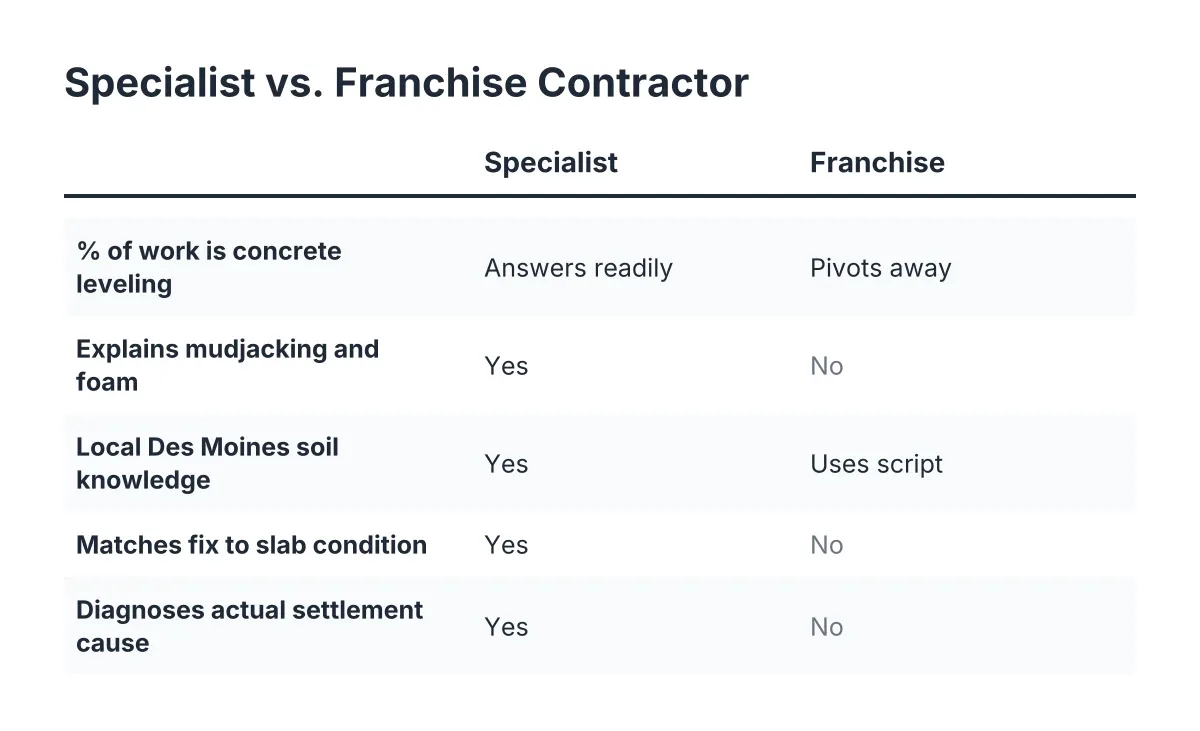
Franchise pages often look local but read from a template. For example, the "Des Moines" page on a national site rarely mentions Iowa's expansive clay soils, our freeze-thaw swings, or how downspout runoff undermines slabs on the north side of a house. That matters. A contractor who understands why your driveway sank is far more likely to fix the cause, not just the symptom. When you call, ask them to explain what's happening under your specific slab. A specialist will talk about soil washout, poor compaction, or drainage, while a script-reader will jump straight to scheduling.
Specialist vs. Generalist: Why the Distinction Matters
General foundation companies make most of their money on structural work like piers and wall anchors. As a result, some steer homeowners toward bigger, more expensive fixes than a sunken sidewalk actually needs. A leveling specialist works the other direction, because their business depends on doing many smaller lifts well. In other words, they have no incentive to upsell you into structural repair you don't need, and that alignment of incentives is worth checking for before you hire anyone.
Beyond that, method flexibility matters. Some companies only offer polyurethane foam because it's what their franchise sells. Others only do mudjacking because it's what their equipment supports. However, the right method depends on your slab's condition, the load it carries, cure time needs, and budget. Mudjacking costs 25% to 50% less than replacing a slab entirely, according to HomeAdvisor, and foam carries its own tradeoffs in price and precision. A contractor who offers both, and explains honestly when each fits, gives you a real choice. One who offers only one method will recommend that method every time, regardless of fit.
Finally, check concrete leveling reviews for Des Moines specifically. Look past the star rating and read for patterns instead: did the crew show up on time, did the final invoice match the quote, and did the slab hold its position through a winter? Reviews that mention a full freeze-thaw season carry more weight than reviews written the week after the job, so weigh recency alongside the rating itself.
Questions to Ask a Mudjacking Contractor Before You Sign
A ten-minute phone call can save you thousands of dollars and a botched lift. With this in mind, ask every contractor the same set of questions and compare their answers side by side. Vague or defensive responses tell you as much as good ones, so pay attention to tone as well as content.
Start with method. Ask why they recommend mudjacking or foam for your slab, and what would change their recommendation. A good contractor explains the tradeoffs plainly: mudjacking uses a heavier slurry and costs less per job, while foam cures faster and adds less weight to unstable soil. If they can't articulate when they would use the other method, they're selling equipment, not solutions.
Next, ask about the cause of settling. Central Iowa's clay soils expand when wet and shrink when dry, and that cycling opens voids under slabs. Additionally, poor downspout placement and backfill settling near foundations cause a huge share of local sinkage. A contractor who identifies your cause can tell you whether the fix will last, while one who skips this step is simply lifting a slab that may sink again.
Credentials, Insurance, and Crew Experience
Ask for proof of liability insurance and workers' compensation coverage. This protects you if someone gets hurt on your property or a lift cracks your slab. Also ask who actually performs the work, because some companies send subcontractors or newly trained crews. Lifting a slab evenly is a skill built over hundreds of jobs, so you want to know the experience level of the people holding the hose, not just the person quoting the job.
Then ask about the warranty. A concrete leveling warranty should state, in writing, how long it lasts, what it covers, and what voids it. However, watch for warranties that exclude "soil movement," because soil movement is the entire reason slabs sink in the first place. That exclusion can make a warranty nearly worthless. A fair warranty covers re-settlement of the lifted section for a defined period, often several years, with a clear process for a return visit.
For a full picture of what these answers should cost you, our contractor cost guide walks through how slab size, sink depth, and method drive the final price.
Red Flags, Fair Quotes, and What to Expect During Concrete Leveling Near Me Appointments
Most concrete leveling contractors are honest. That said, the industry attracts its share of storm-chasers and high-pressure sales operations, and first-time customers are their favorite target. Knowing the red flags of a concrete leveling scam protects both owner-occupiers worried about trip hazards and landlords managing multiple properties.
The biggest red flag is a firm price quoted before anyone sees your slab. Sink depth, void size, and access all change the job, so a sight-unseen number is a sales tactic, not an estimate. Similarly, walk away from anyone demanding full payment upfront, pushing a "today only" discount, or refusing to put the scope of work in writing. Legitimate contractors quote after an inspection, take payment on completion or in reasonable stages, and never need pressure to close a deal. The Iowa Attorney General's consumer protection division publishes guidance on contractor scams if you want an official reference point before you sign anything.
What a Fair Quote Looks Like
A fair quote itemizes the work. It names the method, the area being lifted, the number of injection points or ports, cleanup, and the warranty terms. For context, the national average concrete leveling cost is $1,174, with a typical range of $630 to $1,723, according to Angi and HomeAdvisor data. Your Des Moines quote may land above or below that depending on slab size and access, but a bid wildly outside that range deserves an explanation. If a contractor can't explain their number, get another bid. Our cost guide for hiring a concrete leveling contractor breaks down the pricing variables in detail so you can spot a padded quote quickly.
It also helps to remember the upside. According to Angi, leveling projects can recoup 70% to 90% of their cost in added home value. As a result, a fair-priced lift is one of the better returns among exterior repairs, especially for landlords weighing repair against tenant liability.
What to Expect During the Appointment
A typical concrete leveling appointment moves fast. The crew arrives, confirms the lift plan, and drills small holes in the sunken slab. Then they pump slurry or inject foam beneath it, watching the slab rise in small increments until it meets the adjacent section. Afterward, they patch the holes and clean the area. Most residential jobs finish in a few hours. Foam-lifted slabs usually take traffic within hours, while mudjacked slabs may need a day or so before heavy loads. Before the crew leaves, walk the slab together and confirm the lift matches the quote.
How Location and Season Affect a Concrete Leveling Near Me Search
Where you live in the metro, and when you call, both shape your results more than most homeowners expect. A driveway in an older neighborhood with mature trees often settles differently than a newer subdivision slab, because root systems and older backfill practices behave differently under clay soil. Because of this, a contractor familiar with your specific area can often diagnose the cause faster than one working from a general checklist.
Timing matters too. Many contractors book up quickly in spring, right after freeze-thaw cycles finish reshaping the ground over winter. If you search for concrete leveling near me during that rush, you may face longer wait times and less room to compare multiple bids carefully. Scheduling an inspection in late fall or winter, before the spring surge, often gets you more attention and a more thorough quote. Either way, get your evaluation done well before a slab becomes a safety hazard, since small voids are cheaper and easier to fix than large ones.
Ready to Get Started?
If your driveway, walkway, or patio has settled, you don't have to guess whether a contractor is giving you a straight answer. Des Moines Concrete Leveling Pros inspects your slab, explains whether mudjacking or foam fits, and quotes the job in plain terms with no pressure and no upsell. Call us to schedule a free on-site assessment and get an honest read on what your concrete actually needs.